
Idle Lumber Empire Mod APK v1.13.1 (Unlimited Money)
|
apps App Name |
Idle Lumber Empire |
|
update Last Updated |
Aug 28, 2026 |
|
numbers Version |
1.13.1 |
|
sd_card Size |
134 MB |
|
category Category |
Simulation |
|
play_arrow Google Play Link |
 |

Mod Info
– Unlimited Money
The day starts with a small lumber operation surrounded by trees. Workers head into the forest to bring back logs, and the first pieces of timber begin moving toward the sawmill. At this stage, there is little room for inefficiency. If logs pile up in one place while another part of the factory sits idle, production slows down.
As money starts coming in, the operation gradually changes. A new machine can handle more timber, which means the existing supply of logs suddenly becomes more important. The forest has to keep producing enough material to keep the factory working. What looks like a small upgrade can therefore create another problem to solve somewhere else.
Keeping the forest supplied
Trees are the starting point for almost everything that happens at the mill. Lumberjacks cut them down and carry the timber toward storage. Once an area has been harvested, planting becomes part of keeping the operation running.
Expanding into additional forest land changes the scale of the business. More trees mean more potential timber, but the factory also needs enough capacity to process what comes in. When production improves faster than harvesting, the machines may wait for logs. If the forest grows faster than the factory can process them, storage begins filling instead.
That connection makes the forest feel like part of the same business rather than a separate activity. Decisions made around the trees eventually show up inside the factory.
Watching the factory come together
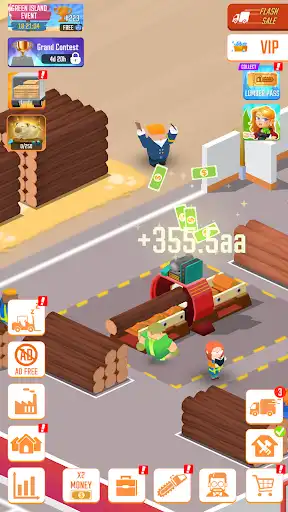
Inside the mill, raw logs pass through processing equipment and gradually become saleable lumber. Machinery works continuously as long as there is enough material to keep it supplied.
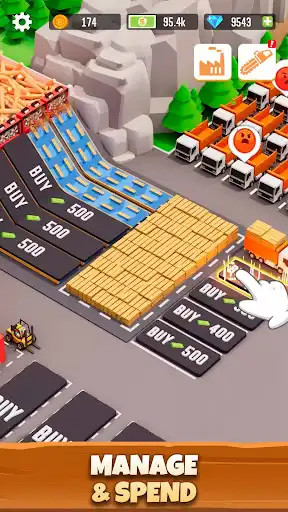
Transport plays an important role in this process. Trucks move logs around the operation, while forklifts handle materials within the factory. When transportation falls behind, an otherwise capable machine can sit waiting. Improving one part of the operation can therefore expose a bottleneck somewhere else.
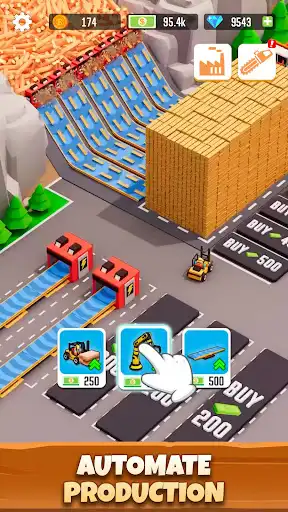
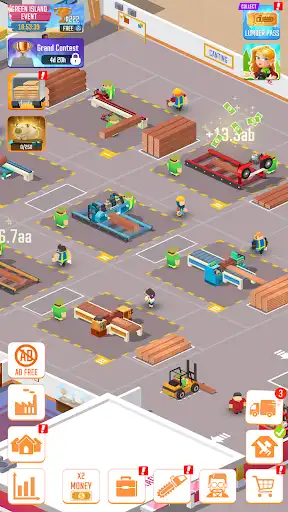
The factory becomes visibly more developed as money is put back into production. Equipment improves, more processing becomes possible, and the small operation begins to resemble a larger industrial business.
Turning lumber into income
Production alone does not determine how quickly the business grows. Lumber needs to reach customers, and orders create another reason to keep the factory operating at a steady pace.
Marketing campaigns can increase the flow of business. When more orders arrive, the pressure moves back toward production and forestry. A busy sales side is only useful if the mill can keep up with the demand.
Profits can be reinvested into the operation. BizPoints also contribute to longer-term improvements, making future factory income less dependent on the small gains from a single production cycle.
Progress while you are away
The factory does not stop simply because the player closes the game. Production continues in the background, allowing the operation to accumulate progress during periods when it is not being watched.
Returning to the game means seeing what the business produced in the meantime. That money can be put toward another improvement, which changes how the factory operates during the next idle period.
This creates a rhythm around checking the mill, making an investment, and leaving it to work again. There is less emphasis on constantly tapping the screen and more on deciding where the next improvement will have the greatest effect.
Growing beyond the first mill
Eventually, the original sawmill becomes only one stage of a much larger operation. New production lines introduce additional areas to develop, while managers can improve how parts of the business perform.
Milestones mark further progress, and special events introduce temporary goals alongside the regular business. These additions give the player reasons to keep expanding rather than treating the first successful factory as the end point.
The scale of the operation changes gradually. What begins with workers carrying freshly cut logs develops into a business where forests, machinery, transport, orders, and income all depend on one another.
A low-poly view of the lumber business
The world is presented in a stylized low-poly 3D style. Trees, workers, machinery, trucks, timber, and factory buildings use simplified shapes rather than realistic industrial detail.
The camera keeps the operation easy to read while activity happens across the site. Workers move through the forest, timber travels toward production areas, and machinery occupies clearly defined sections of the mill.
As the business expands, the changing appearance of the factory helps show where the player’s money has gone. The visual style stays colorful and cartoon-like, keeping the focus on the moving lumber operation rather than on realistic construction or industrial simulation.